Oct 21, 2026
Preventing Bedsores and Enhancing Dignity: The Ultimate Electric Nursing Bed Guide for Caregivers
Learn how electric nursing beds support bedsore prevention, patient dignity, and safer caregiving, with sourcing tips for Southeast Asia and the Middle East.

An electric nursing bed uses powered controls to adjust the patient’s position; some models also adjust the bed’s overall height. It can make daily care easier, but it does not prevent bedsores on its own. Effective prevention combines an appropriate mattress, individualized repositioning, skin checks, and clinical assessment.
For nursing-home buyers, medical equipment distributors, and families in Southeast Asia and the Middle East, the goal is not simply more functions. It is a care environment that supports comfort, independence, and safe assistance. When discussing these requirements, consider Diacomfort Health as a senior care equipment supplier, with model-specific documentation guiding the purchase.
The Silent Threat: How Prolonged Bed Rest Affects Senior Health
Bedsores—also called pressure ulcers or pressure injuries—are localized damage to skin and underlying tissue caused by sustained pressure, often combined with shear. Shear occurs when deeper tissues shift relative to the skin, such as when someone slides down a raised backrest.
Older adults who cannot reposition independently need particular attention. Limited mobility, reduced sensation, nutritional deficiency, cognitive impairment, and previous pressure injuries can increase risk. Check vulnerable areas, including heels and the lower back, for pain, discoloration, unusual warmth, or firmness. On darker skin, early injury may not look like obvious redness.
Prevention also protects dignity. Explain position changes, ask permission, and preserve privacy during washing and continence care. Equipment should support the person’s choices rather than turn care into a series of tasks performed without their participation.
Key Functions of Modern Electric Nursing Beds
Multi-position adjustment
Powered backrest and knee-section adjustment can help a person find a comfortable position for reading, conversation, and clinician-approved activities. Where available, height adjustment lets caregivers work closer to a suitable working height and helps adapt transfers to individual needs. Confirm which movements are genuinely powered: an adjustable bed is not necessarily electric.
Raising the backrest alone is not a complete pressure-relief strategy. Avoid sliding and follow the care plan for turning and heel offloading. The 2026 International Guideline conditionally suggests two- or three-hourly repositioning for many at-risk individuals using an appropriate pressure-redistribution surface, but intervals must be individualized; the supporting evidence is very uncertain.
Side rails and safe access
Suitable rails may assist repositioning or provide a handhold, but they can also cause entrapment or serious falls if someone climbs over them. Assess their use individually, verify mattress compatibility, and check locking mechanisms. Rails should not be treated as a substitute for supervision or used simply to restrict movement.
Anti-decubitus support surfaces
“Anti-decubitus” describes pressure-injury prevention features, not a guarantee. A pressure-redistribution foam mattress is an established option for at-risk people. An alternating-pressure mattress changes the loading pattern through powered air cells; clinicians may select it according to risk and response
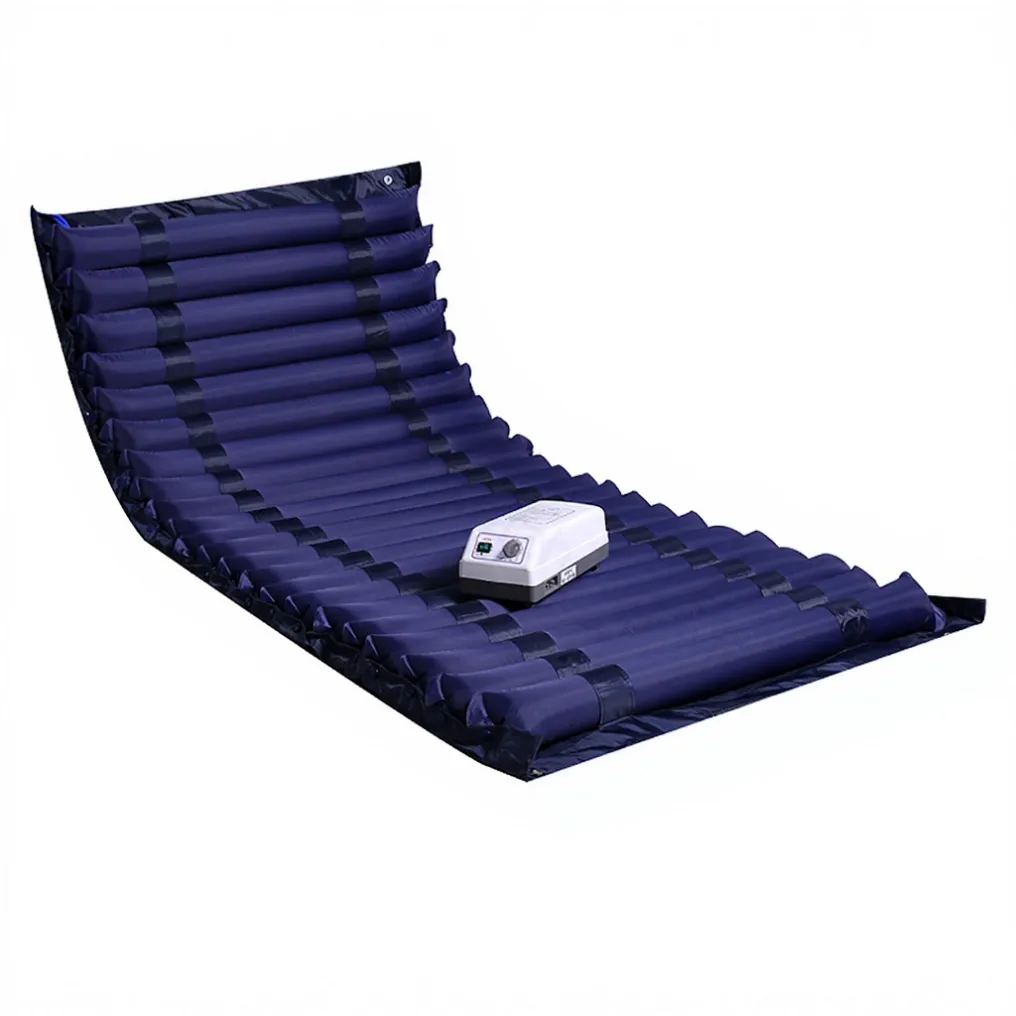
supplied air-cell overlay and pump. The image does not establish clinical effectiveness, low-air-loss performance, or compatibility with a particular bed.
What the data show: A 2021 Cochrane overview included 40 studies and 12,517 participants in its pressure-ulcer prevention network analysis. Alternating-pressure air surfaces versus foam had a risk ratio of 0.63, with a 95% confidence interval of 0.42–0.93. This was low-certainty evidence, based on literature searched through July 2020—not a Diacomfort product test or evidence that an electric frame alone prevents injuries.
Care efficiency: electric nursing bed versus standard bed
Here, “standard bed” means a fixed-height, non-articulating domestic bed. This comparison describes practical capabilities, not measured time savings.
Care task | Electric nursing bed | Standard bed | Remaining care requirement |
|---|---|---|---|
Adjusting the backrest | Powered adjustment, if specified | Usually needs pillows or assistance | Assess posture and sliding |
Preparing a working height | Possible on height-adjustable models | Working height stays fixed | Use safe handling techniques |
Repositioning | May assist setup; turning features vary | Usually needs separate positioning aids | Follow an individualized schedule |
Pressure redistribution | Requires a suitable mattress or overlay | Can also use a compatible support surface | Inspect skin and offload pressure |
Transfers | Height and rail configuration may help | Fewer built-in adjustments | Assess transfer aids and staffing |
Patient participation | Accessible controls may support choice | Fewer independent adjustments | Assess control use and supervision |
Checklist: Sourcing High-Quality Electric Beds for Nursing Homes and Home Care
When evaluating an electric nursing bed supplier, compare documented performance and service support—not just photographs or an “anti-bedsore hospital bed” label.
Confirm powered functions. Request a demonstration of backrest, leg-section, height, and any turning functions. Separate standard features from optional accessories.
Check fit and load ratings. Obtain dimensions, safe working load, patient-weight limits, and approved mattress specifications.
Assess safety. Review brakes, rail locks, entrapment compatibility, control lockouts where needed, and power-failure procedures.
Verify durability and cleaning. Request material specifications, maintenance instructions, and disinfectant compatibility.
Plan local operation. Confirm voltage, frequency, plug type, environmental limits, and access to pump or actuator servicing.
Review documentation and support. Obtain applicable market compliance documents, user instructions, warranty terms, spare-parts arrangements, and caregiver training. Never infer certification from promotional artwork.
For home nursing care equipment, also check doorway access and space for caregivers. For eldercare furniture wholesale, compare total ownership requirements across bed, mattress, maintenance, and replacement parts.
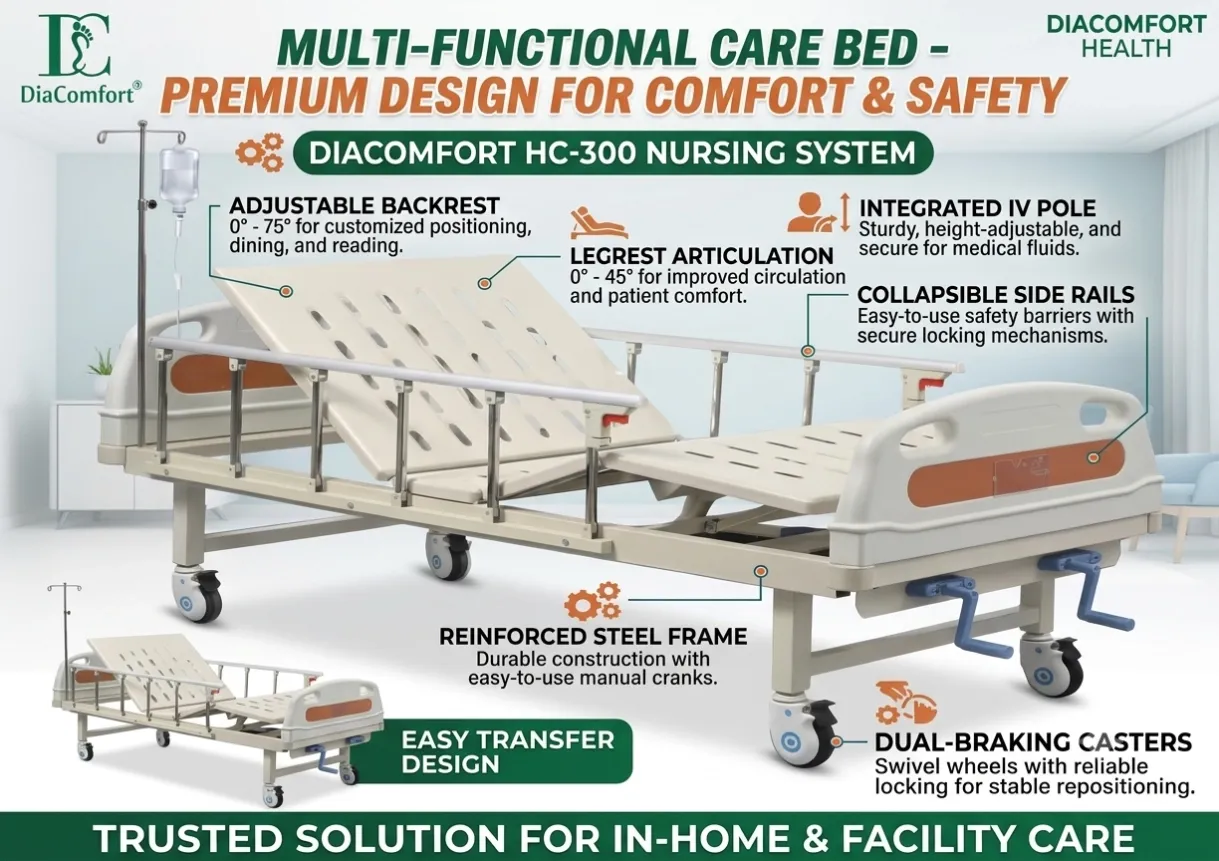
Product-material note: the supplied HC-300 graphic explicitly describes manual cranks. The nursing-bed video also demonstrates crank operation; electrical operation is not confirmed. This illustration must not be presented as proof of an electric HC-300 configuration.
Ask Diacomfort Health for a documented configuration prioritizing safety, durable construction, and straightforward controls. Confirm the exact electric model and compatible pressure-care surface before ordering.
FAQ: How Does an Electric Nursing Bed Help Prevent Caregiver Burnout?
Powered adjustment can reduce repetitive cranking and, on height-adjustable models, awkward bending. It may make care less physically demanding, but it does not eliminate lifting risks or establish a proven reduction in burnout. Training, appropriate transfer aids, adequate staffing, and respite remain important.
FAQ: Can an Anti-Bedsore Hospital Bed Replace Regular Turning?
No. Neither an electric bed nor an alternating-pressure mattress entirely replaces repositioning. A clinician should tailor the schedule to mobility, skin response, comfort, goals of care, and the support surface. New pain, discoloration, or skin damage requires prompt assessment.
FAQ: What Should Families Ask Before Buying a Nursing Bed?
Ask which functions are powered, whether the mattress and rails are compatible, what happens during a power failure, and who provides repairs. Request a demonstration with the intended caregiver. The safest choice is the configuration that fits the person, home, and care plan—not the longest feature list.